
Our Regular Round-Up Of Environmental News
Disappointment as IMO defers decision on Net-Zero Framework
Shipping industry bodies expressed their disappointment at the decision of October’s Extraordinary Session of IMO’s Marine Environment Protection Committee (MEPC) meeting in October to push back taking a decision of the UN Agency’s proposed Net-Zero Framework (NZF) for a year.
International Chamber of Shipping (ICS) Secretary General Thomas A. Kazakos, ICS, said: “We are disappointed that member states have not been able to agree a way forward at this meeting. Industry needs clarity to be able to make the investments needed to decarbonise the maritime sector, in line with the goals set out in the IMO GHG strategy. As an industry we will continue to work with the IMO, which is the best organisation to deliver the global regulations needed for a global industry.”
In a statement IBIA noted: “The MEPC Special Session this week demonstrated that the issue of reducing GHG emissions from ships, and in particular, the pricing of emissions, is politically contentious for many countries to the point that achieving a consensus at this stage is not possible and means the draft amendments for consideration will now have to be revised before being tabled again and pausing it for one year.
IBIA had expected, together with a significant number of international associations, a different outcome of the extraordinary MEPC. IBIA supported the adoption of the ZNF and were already engaged in crucial work on the detailed guidelines. Meanwhile, a majority of IMO’s Member States weren’t prepared to move ahead [to make] shipping the first sector with a global regulatory framework to decarbonise.”
Environmental campaign groups were scathing in their responses. US-based environmental group Ocean Conservancy’s shipping programme director, Delaine McCullough, said in a statement: “The failure of IMO member states to clinch this agreement is a major setback for people and the planet. It’s disgraceful that climate action has been delayed when we see the devastating impacts every day, and when shipping fuels have been tied to 250,000 premature deaths and 6 million cases of childhood asthma every year.”
She asserted: “The agreement would have slashed carbon emissions and saved lives. A world without this agreement is dirtier and more dangerous for people, wildlife and the ocean. While the agreement was not perfect, it was an important step to deliver on the IMO’s commitment and send clear signals to an industry that was not only asking for a global framework but actively supported this deal. While this delay is a serious setback, there is still a major opportunity to put the sector on a zero-emission pathway. In April 2026, the IMO will continue the revision of its main energy efficiency measure, the Carbon Intensity Indicator (CII), which would reduce fuel burn through technical and operational measures like simply slowing ships down. Strengthening the CII is absolutely critical to immediate emission reductions, necessary to meet the IMO’s 2030 goals.”
However, responses were mixed. Marine fuel brokerage NSI is reported as saying that a majority of its clients in a survey opposed the adoption of the IMO’s net-zero framework.
Prior to the IMO meeting, at London International Shipping Week, there had been a number of calls for IMO to slow its moves toward NZF.
CEO and President of diverse maritime services provider Columbia Group, Mark O’Neil, suggested that the “runway for widespread adoption of alternative fuels is much longer and much narrower than anyone anticipated” and he urged the industry “to slow down in its urgency in ensuring all crew members are fully trained.”
According to Columbia, it is wholly “committed to realistic and achievable decarbonisation of marine fuels” but Mr O’Neil echoed sentiments expressed earlier in the week by other prominent speakers that “the reality of alternative fuels being widely adopted is a lot further away than originally anticipated!”
He said: “At an earlier event this week I was perhaps a lone voice in calling for a reality check in relation to the adoption of alternative fuels. When I got back to the hotel, I saw that ABS had said the runway for the widespread adoption of alternative fuels would be much longer than anticipated, I would warrant that not only will it be much longer but also far narrower than we all thought a few months or years ago.”
O’Neil elaborated: “The reason I called for a reality check was that it was quite rightly pointed out that the number of vessels that are alternative fuel-capable in itself is quite a large number. But that doesn’t mean those vessels are ready to burn alternative fuels. The other aspect of this reality check is do we believe the world is ready to invest considerable sums of money in the scalability needed to provide shipping, and other industries, with alternative fuels? There are huge geopolitical tensions at the moment and there are huge financial constraints throughout Europe. With those financial constraints come different priorities on money – there is a toss-up in setting up the infrastructure surrounding alternative fuels or focusing on the social policies. Those governments must decide what is more important and I would warrant it would be social policies.”
Emission reductions “to continue, with five year delay in US”
The global shift towards cleaner energy remains robust even though the pace of the energy transition in the US has slowed sharply due to recent policy reversals. According to the ninth edition of classification society DNV’s Energy Transition Outlook, the US slowdown will have only a marginal effect on worldwide progress, as momentum continues to build elsewhere – most notably in China.
Published just before the October MEPC meeting the paper says that, in the US, policy reversals and renewed support for fossil fuels are expected to delay emission reductions by about five years, with annual carbon dioxide emissions projected to be 500 to 1,000 million tonnes higher than previously forecast. However, it also notes: “Meanwhile, China is setting new records for renewable energy deployment, accounting for 56% of global solar PV installations and 60% of new wind power additions this year alone. Its clean technology exports also continue to drive the energy transition worldwide.”
DNV forecasts a slightly slower transition with the energy mix to be split 51%-49% between fossil and non-fossil fuels in 2050. Likewise, 2050 global carbon dioxide emissions are now forecast to be 4% higher compared to last year’s Outlook.
“It is more important than ever to evaluate the energy transition from a global perspective. The global energy transition is not stalling – it is evolving, with momentum shifting to regions that are doubling down on clean technologies,” said Remi Eriksen, Group President and CEO of DNV. “Security has become the dominant driver of energy policy, and as our forecast shows, this is in sum accelerating the shift to renewables.”
EU shipping emissions at recent high
EU shipping emissions reached their highest levels last year since the EU introduced mandatory reporting in 2018, according to an analysis of official EU data by environmental campaign group Transport & Environment (T&E). It notes that a jump of 13% came despite a down tick in EU-related seaborne trade, with disruption of trade through the Red Sea likely leading to longer routes.
T&E which calls for an expansion of emissions pricing to smaller vessels, says: “Last year’s record emissions levels show how important it is that emissions are priced by the EU.”
Maersk retrofits time-chartered ships
In a large-scale programme involving 50 different shipowners, A.P. Mellor – Maersk (Maersk) is, “in close collaboration with the owners”, retrofitting around 200 vessels in its time-chartered fleet. The main aim of the programme is to reduce the slot cost by improving fuel efficiency and cargo-carrying capacity leading to a decrease in both cost and greenhouse gas emissions.
“Our medium- and long-term chartered fleet makes up a significant proportion of our operations as well as of our total fuel consumption. By working closely with our partners, we aim to implement solutions that not only reduce emissions but also enhance the overall competitiveness of our fleet,” says Ahmed Hassan, Head of Asset Strategy and Strategic Partnerships at Maersk.
12/12/2025
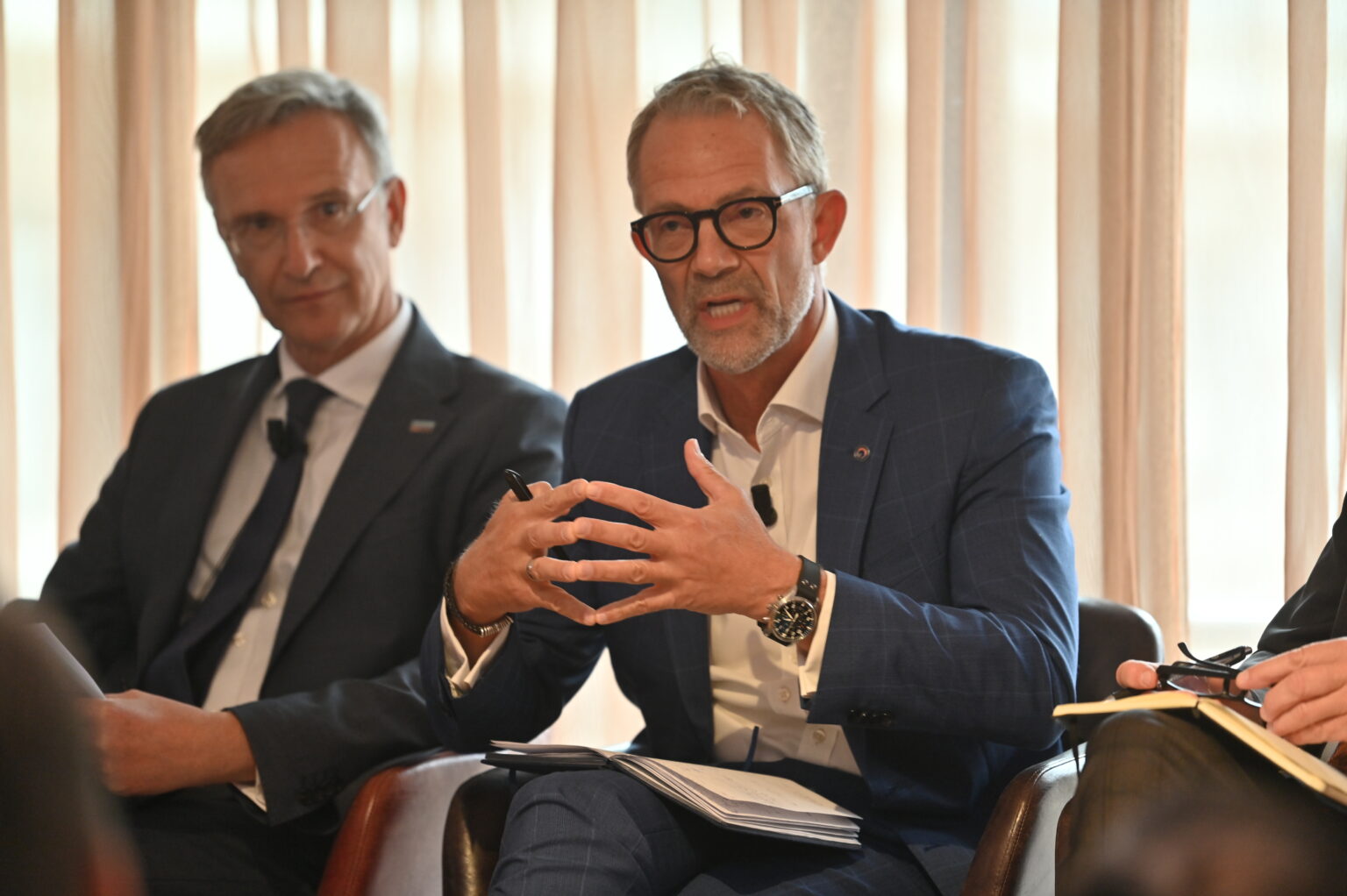
Image Credit: Columbia’s Mark O’Neil talking at London International Shipping Week
get
in touch

Constructive Media
Constructive Media
Hornbeam Suite
Mamhilad House
Mamhilad Park Estate
Pontypool
NP4 0HZ
Tel: 01495 239 962
Email: ibia@constructivemedia.co.uk

On behalf of:
IBIA London Office
Suite Lu.231
The Light Bulb
1 Filament Walk, Wandsworth
London, SW18 4GQ
United Kingdom
Tel: +44 (0) 20 3397 3850
Fax: +44 (0) 20 3397 3865
Email: ibia@ibia.net
Website: www.ibia.net

Emails
Publisher & Designer: Constructive Media
ibia@constructivemedia.co.uk
Editor: David Hughes
anderimar.news@googlemail.com
Project Manager: Alex Corboude
alex@worldbunkering.net