
Retrofitting To Cut Fuel Use
Corsica Linea ferry gains significant fuel savings with Wärtsilä package
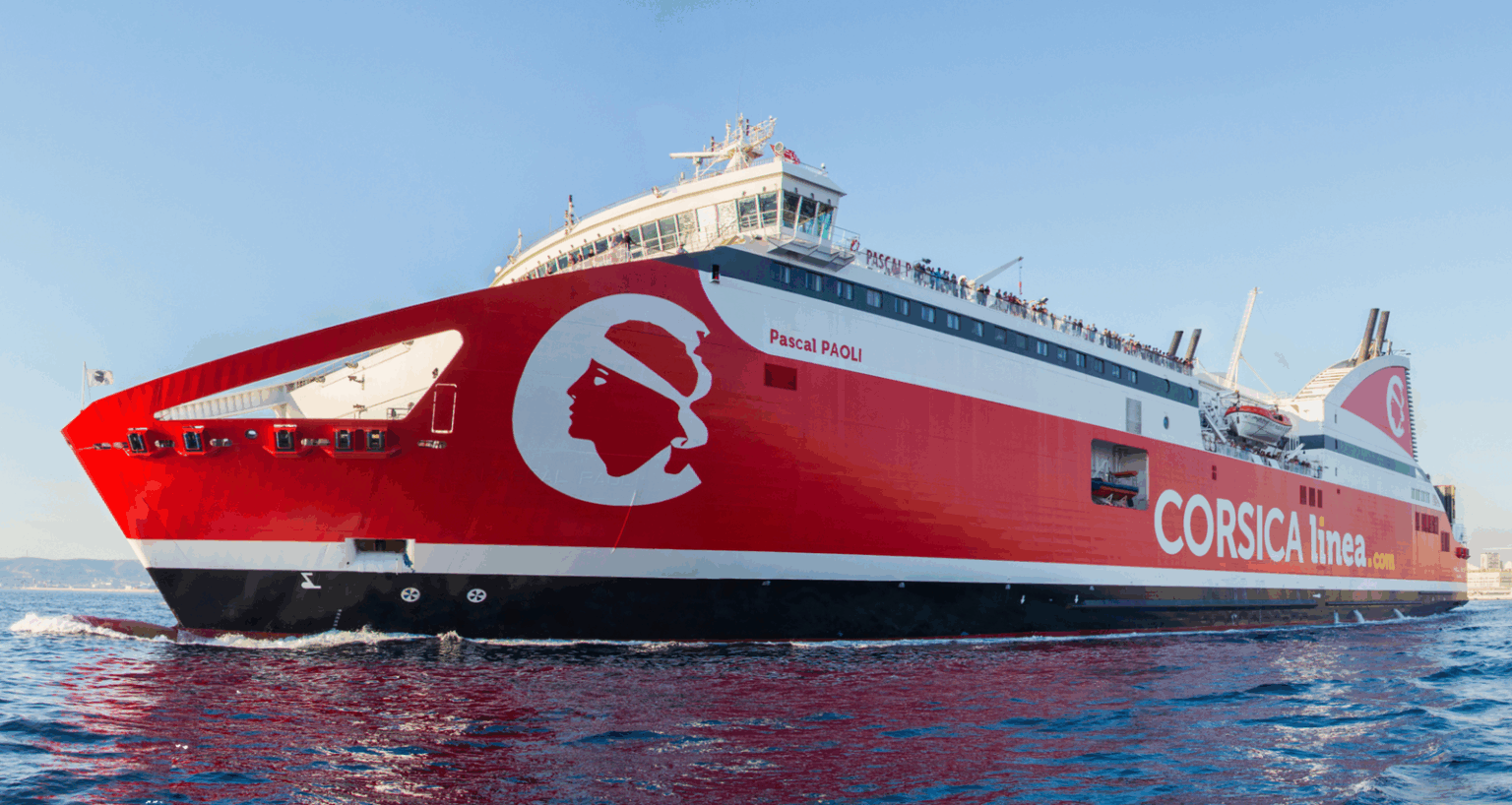
Technology group, Wärtsilä says its retrofit package for the Corsica Linea ferry Pascal Paoli has resulted in fuel savings of up to 22%. This significant gain in energy efficiency on each trip has been made possible by the installation of a new twin screw controllable pitch propeller (CPP) system with blades optimised for the ship’s operating profile, the Wärtsilä EnergoProFin energy saving propeller cap, a controls retrofit, and combinator curves for the ship’s various operating modes.
These upgrades, which were completed at the end of 2024, were validated through CFD (computational fluid dynamics) open water simulations, and confirmed during sea trials with the chief engineer. In monetary terms, the fuel savings equate to an estimated US$7,700 per trip. The related reduction in emissions represents a massive step in Corsica Linea’s decarbonisation journey, allowing the company to remain compliant with the stricter requirements on carbon emissions.
Xavier Esnault, energy transition project manager at Corsica Linea: “The fuel savings are important, both from a cost perspective, as well as supporting our decarbonisation strategy to reach a reduction of 40% of our CO2 emissions by 2030.”
The Pascal Paoli is a 174-metre long RoPax ferry operating between Marseille and Bastia. She has two Wärtsilä 46 engines per shaft line and a number of operating modes, including sailing and manoeuvring with one or two engines per shaft line. The changes resulting from the retrofit project did not impact the vessel’s manoeuvrability.
Shipping faces pressure to prove emissions cuts as new data highlights gap between predictions and reality
Optimising energy
Oceanly, a provider of digital solutions for the maritime industry, has reported a 60% success rate from its ECOPAC energy optimisation system.
As the industry moves towards decarbonisation, precise and accurate data-driven proof of performance is essential, says Frederick Lerche-Tornoe, CEO at Oceanly.
Latest findings from Oceanly, which analysed outcomes from its ECOPAC energy optimisation system, are that in more than 60% of recent cases, its predictive figures aligned closely to real-world implementation. The purpose was to demonstrate how predictive modelling and real-time monitoring can deliver the transparency increasingly required by regulators and charterers.
Launched earlier this year, ECOPAC optimises the speed of seawater pumps and engine room ventilation fans using intelligent variable frequency drives (VFDs). Unlike conventional systems that operate at constant speeds regardless of cooling demand, ECOPAC dynamically adjusts performance based on each vessel’s operating conditions. This approach delivers substantial fuel savings that can be accurately forecast in advance.
“Seawater pumps, fresh water pumps and engine room ventilation systems are among the most overlooked consumers of energy onboard,” said Allan Nielsen, CEO at Danavis Engineering “Our approach is grounded in evidence. For example, when vessels operate in colder waters—below 22°C to 22°C—savings can exceed 60% as pumps can run at significantly reduced speeds.”
Before each installation, the ECOPAC team conducts a comprehensive assessment of a vessel’s operational profile. Owners provide detailed records of trading areas, daily sea temperatures, time at sea, and port stays—data that is critical to modelling energy-saving potential accurately. Where temperature records are unavailable, historic global datasets are used to establish a reliable baseline.
In a recent installation on a vessel operating in average seawater temperatures of 22°C, ECOPAC projected annual fuel savings of approximately US$89,000 looking only at the sea water pumps on board based on prevailing fuel prices alone. Additional compliance-related savings, such as avoiding EU emissions penalties, would further increase the financial benefits.
Oceanly asserts that a key differentiator is ECOPAC’s ability to validate results in real time. Once installed, onboard control units continuously record pump and fan performance, frequency, runtime, and energy consumption. Through Oceanly’s cloud-based performance monitoring platform, Oceanly Performance, this data is transmitted seamlessly and transformed into intuitive dashboards and reports accessible to shipowners and operators anywhere in the world.
11/12/2025
get
in touch

Constructive Media
Constructive Media
Hornbeam Suite
Mamhilad House
Mamhilad Park Estate
Pontypool
NP4 0HZ
Tel: 01495 239 962
Email: ibia@constructivemedia.co.uk

On behalf of:
IBIA London Office
Suite Lu.231
The Light Bulb
1 Filament Walk, Wandsworth
London, SW18 4GQ
United Kingdom
Tel: +44 (0) 20 3397 3850
Fax: +44 (0) 20 3397 3865
Email: ibia@ibia.net
Website: www.ibia.net

Emails
Publisher & Designer: Constructive Media
ibia@constructivemedia.co.uk
Editor: David Hughes
anderimar.news@googlemail.com
Project Manager: Alex Corboude
alex@worldbunkering.net