
Solar Goes To Sea
Seagoing commercial vessel installs solar panels
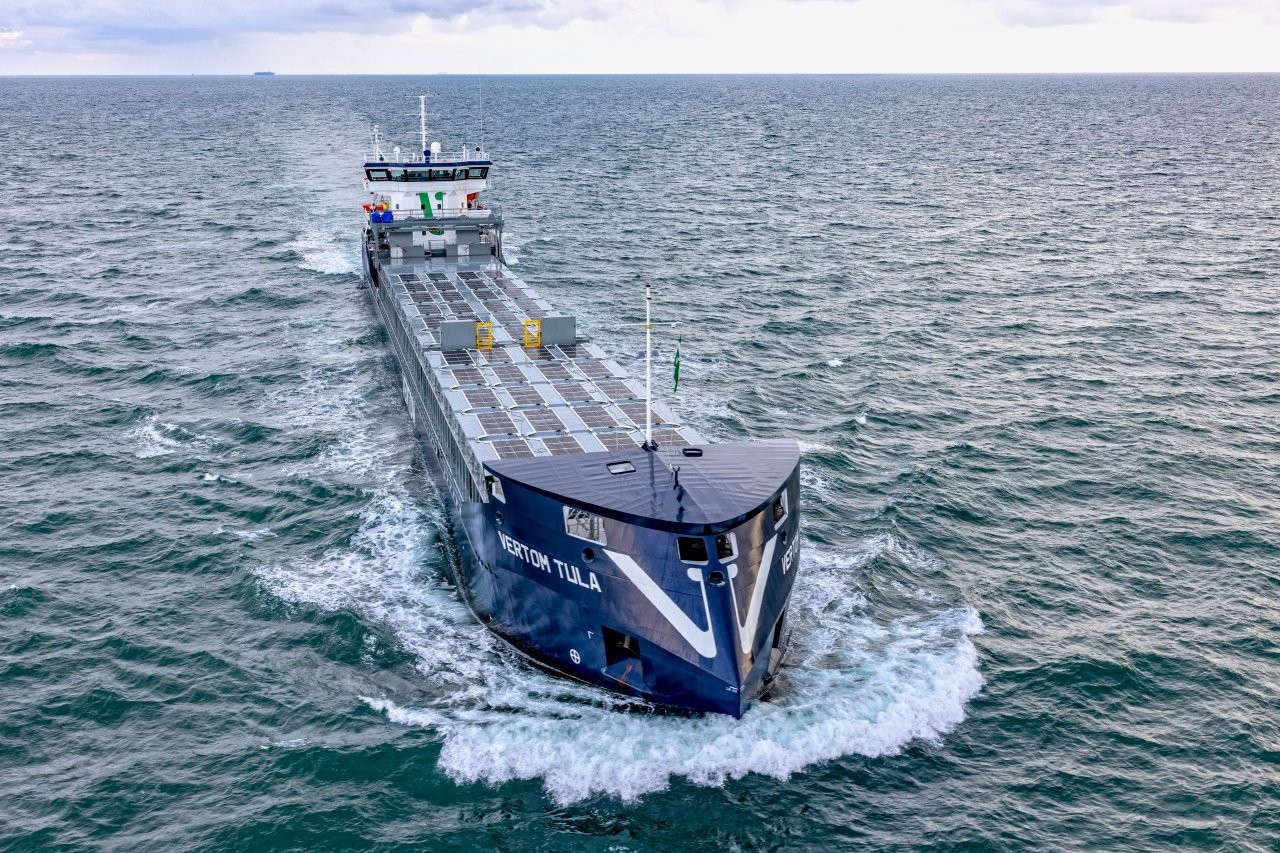
Dutch maritime solar company, Wattlab reports it has delivered a seaworthy solar energy system for globally operating shipping, trading, and maritime services company Vertom.
It has been installed on the recently-delivered, 7,280 dwt diesel-electric multi-purpose cargo vessel Vertom Tula. The solar system represents a major technical milestone and a step forward for sustainable shipping. Wattlab has delivered and installed 44 Solar Flatracks that will provide power to onboard systems, reducing 20% of the hotel load.
Dutch-based Vertom operates a fleet of over 100 vessels, ranging from 1,500 dwt to 12,000 dwt. It carried out two pilot projects with Wattlab before deciding to fully outfit this newbuild.
After production and assembly in September in Wattlab’s brand new production facility in Rotterdam, the 44 Solar Flatracks were installed onboard within a day in the Port of Harlingen. Bo Salet, co-founder and CEO of Wattlab, explains that the Solar Flatracks can be installed in a minimum amount of time using container twist lock fittings: “For shipowners, time is money, so speed and ease of use are important. Furthermore, we know that ‘space is money’ too. Hence, should the panels need to be removed to make way for a special type of cargo, the crew can easily stack and store them all on the footprint of one 20ft container.”
“During the pilots, the test results showed that the Solar Flatrack system performs well in the tough coastal shipping environment,” says Thomas van Meerkerk, Business Development Manager at Vertom. “Based on the results of our own and TNO’s research in the past months, we consider Wattlab’s Solar Flatrack an effective option for reducing GHG and pollutant emissions. Of course, these things also depend on the conditions our vessels operate in, but it’s clear that the system can provide both a positive ROI and contribute to CO₂ reduction in shipping.”
Bo adds: “Another benefit is that the panels can stay on the hatch covers during loading and discharging operations. The crew was sceptical at first, fearing a lot of extra work. However, they soon learned that in practice, Solar Flatracks are easy to use and require minimal maintenance. For example, there’s no salt crust formation, because the water can drain freely from the panels.”
Dutch independent, globally recognised research organisation TNO has validated the CO2 emission reduction and ROI time of the system. Their report will be published shortly.
Wattlab says: “Having a first full-scale system operational on a coaster marks an important step in the evolution of maritime decarbonisation strategies. With rising regulatory pressure (e.g. FuelEU Maritime, EU ETS) and volatile fuel prices, shipowners and operators are seeking ways to diversify their onboard energy mix. Wattlab’s scalable solar solution now offers a practical and proven solution for coastal and short sea vessels.
This project sets the stage for wider adoption across the sector, delivering emission reductions, fuel savings, and energy resilience without compromising deck space or cargo flexibility.
Image Caption: Verom Tula
Image Credit: Wattlab
12/12/2025
get
in touch

Constructive Media
Constructive Media
Hornbeam Suite
Mamhilad House
Mamhilad Park Estate
Pontypool
NP4 0HZ
Tel: 01495 239 962
Email: ibia@constructivemedia.co.uk

On behalf of:
IBIA London Office
Suite Lu.231
The Light Bulb
1 Filament Walk, Wandsworth
London, SW18 4GQ
United Kingdom
Tel: +44 (0) 20 3397 3850
Fax: +44 (0) 20 3397 3865
Email: ibia@ibia.net
Website: www.ibia.net

Emails
Publisher & Designer: Constructive Media
ibia@constructivemedia.co.uk
Editor: David Hughes
anderimar.news@googlemail.com
Project Manager: Alex Corboude
alex@worldbunkering.net